
Ask anyone in New Zealand to name the big players in a category, and they’ll do it without pausing. In a market this size, being known isn’t the hard part.
Being part of how people talk is. That’s the gap most brand awareness campaigns never cross, and it isn’t a budget problem. Recognition and cultural presence are produced by different mechanisms, and nearly every campaign is built for the first one.
What closes it, across the experiential marketing work we’ve delivered around the country, comes down to two things: giving people something to do, and giving them a reason to do it again.
What a Brand Awareness Campaign Is Actually Trying to Do
A brand awareness campaign is a planned effort to make more of the right people know your brand exists and think of it when your category comes up. Most get measured on reach, recall and share of voice, so most get optimised to produce recognition.
Recognition is worth having. It’s also where the majority of campaigns finish, because when the reporting ends at recall, the work ends at familiarity. A brand activation starts from the other end. It asks people to take part.
How Brand Recognition and Top of Mind Awareness Differ
Brand recognition means someone identifies you when prompted. They see the logo, hear the name, and place it. Top-of-mind awareness goes further, so you’re the brand they name before anyone prompts them at all.
Both measure whether you’re known. Neither measures whether anyone cares. A brand can be recognised right across its category and still be swapped for a competitor at the shelf without a second thought.
Why Recognition Stops Short
Familiarity is reliable, and it’s fast. Show people something repeatedly, and they tend to like it more, which is one of the better-replicated findings in psychology. Robert Zajonc identified it in 1968, and Robert Bornstein’s 1989 review of nearly 200 experiments confirmed it was real.
What gets left out of the summary is the shape of the curve. A 2017 re-analysis by Montoya and colleagues, covering 268 curves across 81 studies, found that liking rises with repetition, peaks, and then falls away. Psychologists call it an inverted U, and the explanation is that two forces run against each other. Familiarity warms people up. Repetition eventually bores them. Past the peak, more exposure starts working against you.
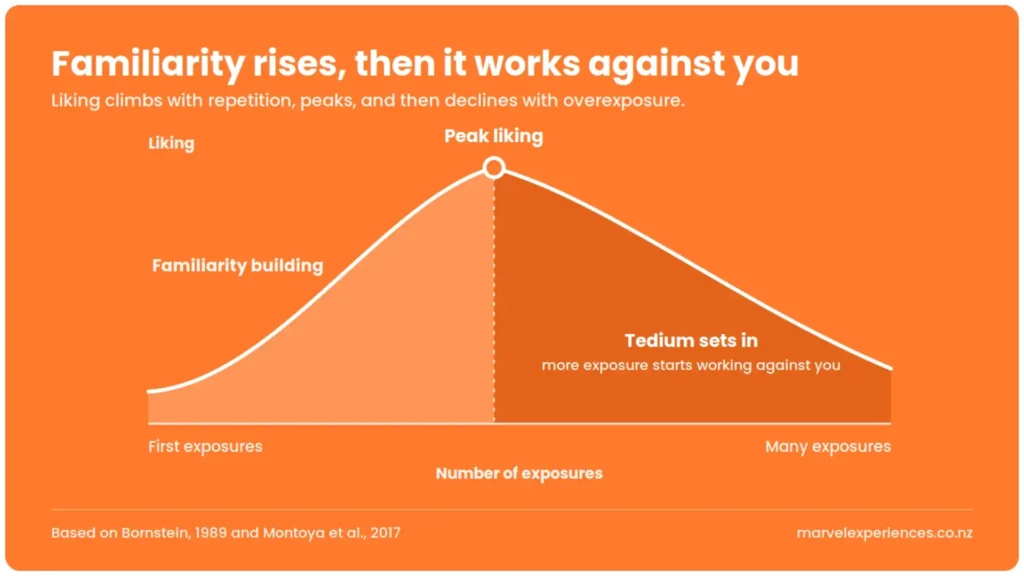
Nobody can tell you where your peak sits. It varies by what you’re showing people and who they are.
What we can say is that in a market this size, the ceiling arrives early. Most category buyers in New Zealand already know the major players exist, so awareness is rarely the constraint by the time a brand is spending seriously against it.
Where the Reach Argument Still Holds
The strongest case against all of this comes from Byron Sharp and the Ehrenberg-Bass Institute, whose work shows that brands grow mostly by reaching more category buyers rather than deepening loyalty among existing ones. On that reading, broad awareness is the job, and anything reaching a smaller group is a distraction.
We think that’s largely right, and it’s why we don’t tell clients to stop advertising. But mental availability, the odds your brand comes to mind when someone is actually choosing, is built from reach and from consistency, the same distinctive assets held steady over years.
That second half is where live experience does its work. The argument isn’t reach versus experience. It’s what you’re being consistent about.
What Brands With Cultural Presence Do Differently
Three habits turn up again and again in the campaigns we’ve delivered that changed how people talked about a brand.
They Build Something People Can Return To
A single large campaign produces a spike. Something that recurs produces a habit, because the second encounter carries everything the first one set up.
This is where most brands assume they’re priced out, and they aren’t. Returning doesn’t have to mean an annual event. When we built a portable shot put arena for the Commonwealth Games and toured it around the country, the format repeated even though each stop was new: the same invitation, recognisable by the third town. Repetition across places is a cheaper rung than repetition across years, and it does the same work.
They Behave the Same Way in the Details
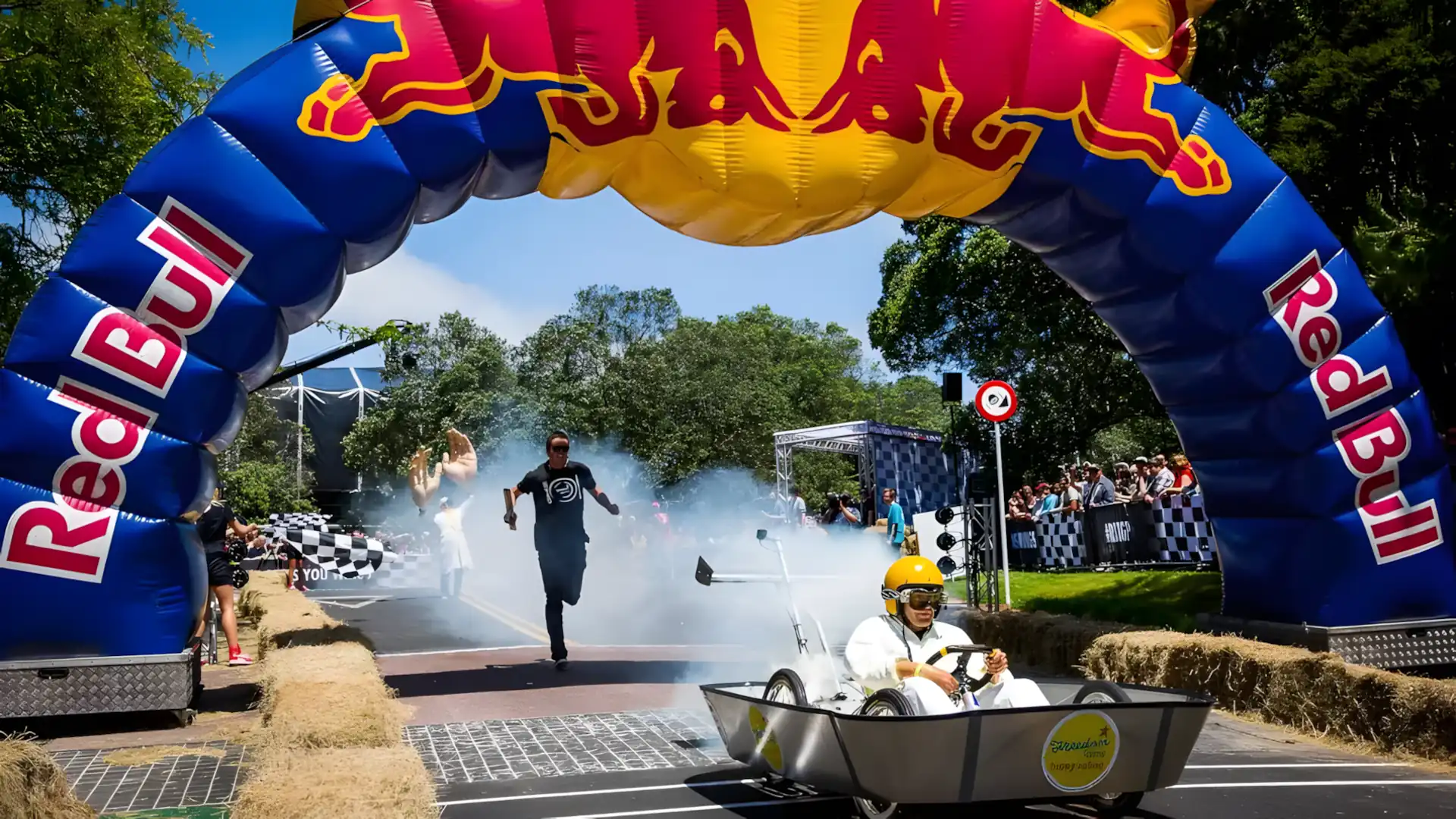
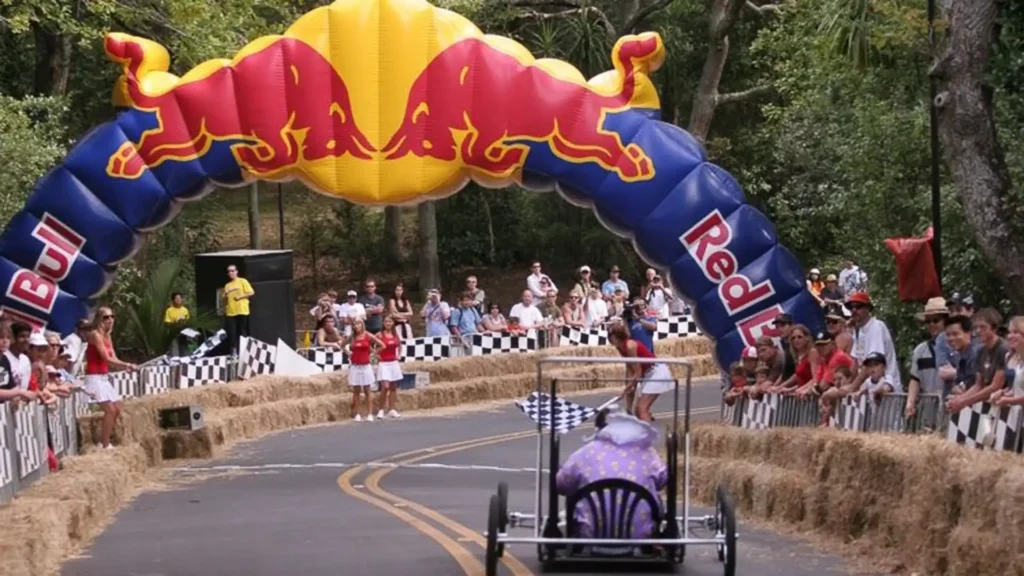
When we built the VIP experience for Red Bull’s Trolley Derby, the brief was clear that the hospitality couldn’t sanitise the event. Trolley Derby runs on noise and spectacle. Guests needed comfort and service while sitting inside that energy, close enough to feel it.
We designed the VIP zones to sit within the event, handled the catering, the bar and the entertainment, and cleared every regulatory detail from liquor licensing onward. The brand held its character in a layer of the experience nobody would ever write a case study about. That’s what people read as authenticity.
They Hand the Thing Over to the Audience
Nobody recounts an ad they saw. They recount what they did. The Great Olympic Ice Block Challenge worked because the public did the thing themselves rather than watching someone else do it, and a well-built brand activation turns that participation into something people carry with them.
What It Looks Like When All Three Hold
We didn’t wait for a brief. We looked at New Zealand’s high country, saw a gap in the global multisport calendar, and built a race concept around it. Then we took it to Red Bull Global and made the case for why it deserved to carry their name.
Red Bull Defiance became a two-day multisport race through eight private high country stations around Wānaka. We conceptualised it, secured Red Bull’s endorsement, then managed full logistics across multiple remote stations and delivered the event four years running, each edition building on the last. Roughly 200 athletes and more than 80 staff were coordinated across terrain that offered none of the conveniences of a city event.
The scale of any single year mattered less than the fact of the next one. The race came back the following summer, and the one after that. Athletes trained for it. It became a fixture rather than a campaign, and Red Bull owned it outright.
The race was the brand, expressed as something people could enter.
What This Means for Your Next Campaign
One question worth asking of any brand awareness brief is what will still exist in three years. The campaigns that build lasting awareness are the ones people can take part in and return to, rather than the ones they only see.
Most brands can’t commission a race, and they don’t need to. The principle is the return visit, not the scale. A format repeated across five towns, a moment that happens the same week every year, a mechanic people recognise the second time they meet it, each of those buys the same thing a flagship property does, at a fraction of the commitment. What matters is that it comes back.
Ready to Build Something That Outlasts a Campaign
We design and deliver live experiences that earn brands a place in people’s year, not just a place in their memory. Start a conversation with the team to talk through what that could look like for your brand.